
Allē
AbbVieMedical
4.4824.00 Reviews
- Version
- 9.6.0
- Installs
- 1.00M
- Age Rating
- Everyone
Screenshots

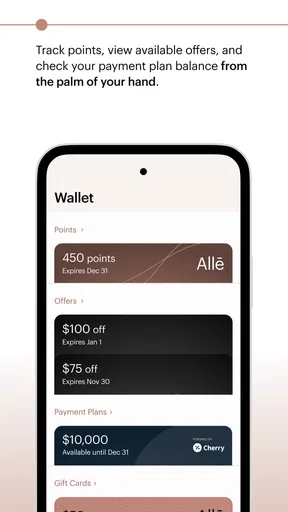
Our Review of Allē
 Analysis by Appyee
I approached Allē as a practical companion for people who already use participating aesthetic and wellness services and want a simpler way to keep track of their benefits. It is a free medical-category app from AbbVie, but it does not feel like a clinical reference tool or a replacement for speaking with a qualified professional. Its focus is much narrower and more useful: bringing points, offers, and selected content into one place instead of leaving them scattered across emails, paper receipts, and provider conversations.
After spending time with it, my impression is that Allē works best when you treat it as a membership and planning tool rather than a general health app. The value depends heavily on whether the services and offers available through the program match what you already use. If they do, the app can make routine account management less annoying. If they do not, installing it may not add much to your day.
How Allē feels in its current form
The first thing I noticed is that the app is built around quick access rather than long reading sessions. The main reason to open it is usually obvious: check your points, look for an offer, or browse content selected for the program. That narrow purpose is a strength because it avoids turning a simple account check into a maze of unrelated health tools.
The interface is most useful when I already know what I want to do. I can imagine opening it before an appointment to see whether there is a relevant offer, or checking afterward to confirm that my account activity is reflected correctly. That makes it more practical than a broad wellness app for this particular task, although it also means there is little reason to browse aimlessly.
Allē is marked for Everyone, which makes sense for an account and offers application rather than an app intended only for medical professionals. Still, the age label should not be confused with medical advice. Content about treatments or aesthetic services deserves the same care as any other health-related information, especially when an offer might make a procedure feel more urgent than it really is.
The app has reached a sizeable audience, with more than 500,000 installs and an average score of 4.5 from roughly 1,800 ratings. Those figures suggest that the basic concept is working for many users, but they should not replace checking whether the program is actually relevant to your provider or preferred services. A high rating cannot make an unavailable offer useful to someone in a different situation.
A realistic everyday workflow
Here is the situation where I find the concept easiest to recommend. Imagine that I have an appointment coming up and I want to understand what benefits may be available before I commit to anything. I open Allē, review the points and current offers, and save myself from searching through old messages. At the appointment, I can ask the provider how the offer applies and whether the service is appropriate for me. Afterward, I return to the app to keep the account information in one place.
The important detail is the order. I would not make a treatment decision solely because an offer appears in the app. I would first decide whether the service fits my needs, then use Allē to organize the financial or loyalty side of that decision. That small change in workflow helps keep the app useful without allowing promotions to drive healthcare choices.
Another helpful habit is to check the details of an offer before assuming it is immediately usable. A promotion may involve conditions, a particular participating location, or a limited period of relevance. I would treat the offer screen as a starting point for questions, not as a guarantee that every provider will apply it in exactly the same way.
What the latest version tells me about its direction
The current version is 9.1.0, which gives the app a more mature feel than a newly launched experiment. Its release history began on February 15, 2017, so the product has had time to settle around its central purpose: account access, benefits, and curated material. I see that longevity as a positive sign for users who want continuity rather than a short-lived promotional tool.
At the same time, a version number alone does not tell me that every part of the experience has been transformed. The clearest evidence in the current product is its continued emphasis on convenience: points and offers are placed near the center, while content supports the wider experience. I would describe the evolution as refinement of a focused service rather than a change into a full medical platform.
That distinction matters for expectations. Someone downloading it today should not expect appointment scheduling, diagnosis, medication management, or a complete record of personal care. Allē is better understood as a branded benefits layer around eligible services. Its development appears to have strengthened that role instead of trying to compete with clinical portals or general health trackers.
For an existing user, the current version should be judged by whether it makes familiar tasks faster and clearer. If the account view is easy to reach and offers are easier to understand than they were through scattered communications, the update path is worthwhile. If the main problems involve a provider, eligibility, or the underlying program itself, an app update cannot solve all of them.
Where the app saves time
The strongest advantage is consolidation. I do not have to remember which message contained a points balance or which conversation mentioned a promotion. Having those elements gathered in the same app creates a more reliable routine, especially for someone who uses the program occasionally and otherwise forgets the details between visits.
The curated content also has a practical role when used carefully. It can help me frame questions before speaking with a provider, such as what I want to understand about a service or which details need clarification. I would not use it as my only source for safety decisions, but it can make a consultation more focused than arriving with no preparation at all.
There is also a subtle benefit for household organization. If I am comparing several possible appointments or trying to plan spending over time, seeing the available benefits in one place gives me a clearer starting point. I can make a note of what I need to ask, then avoid repeatedly contacting support just to locate basic account information.
The most useful role for Allē is reducing friction around an existing relationship, not creating a reason to purchase a service. That is the standard I would use when deciding whether to keep it installed.
Where the experience can become frustrating
The same narrow focus that makes the app simple can make it feel limited. If I am looking for a complete health record, detailed treatment tracking, or a direct way to discuss symptoms, I would choose a provider portal or a dedicated medical service instead. Allē is not designed to replace those tools, and trying to force it into that role would be disappointing.
Offers can also introduce uncertainty. The app may show an attractive benefit, but the practical value still depends on the participating provider, the service involved, and the terms attached to it. I would always confirm the details before booking or paying. This is not a criticism unique to digital offers; it is simply the trade-off between convenience and the fine print that comes with promotional programs.
Another limitation is that the app may be less useful between appointments. Once I have checked my points and reviewed anything relevant, there may be no compelling reason to open it again until I am planning another service. That is perfectly acceptable for a utility app, but users expecting daily engagement should not mistake occasional usefulness for a continuous health companion.
Content also needs a critical eye. Curated material can be easier to digest than a long search, yet it may naturally reflect the services and products connected with the program. I would compare important claims with advice from an appropriately qualified clinician and avoid treating promotional education as personalized medical guidance.
Who should use it and who should skip it
I would recommend Allē to someone who already participates in the program, visits a participating provider, or wants a central place to review points and offers before an appointment. It is particularly suitable for people who dislike searching through inboxes and who prefer checking account information on a phone. The free price removes the usual subscription decision, so the real question is relevance rather than cost.
I would also consider it useful for a person who is organized but busy. A short check before an appointment can help identify questions and prevent an offer from being forgotten. For occasional users, that may be enough value to justify keeping the app available even if it is not opened every week.
I would skip it if I do not use eligible services, do not expect to interact with the program, or want a general-purpose medical app. A primary-care portal is a better choice for test results and clinician communication. A medication app is better for doses and reminders. A general wellness tracker is better for habits, activity, or sleep. Allē should not be selected simply because it sits in the medical section of an app store.
I would also be cautious about recommending it as a decision-making tool for someone who feels pressured by promotions. In that case, it may be healthier to decide on care independently, ask a clinician for advice, and consult the app only afterward for account administration.
Questions I would resolve before relying on it
A common question is whether the app is worth downloading if I only want to see offers. My answer is yes only when those offers relate to services I genuinely might use. If I am merely curious, the benefit is likely too occasional to matter. The app becomes more useful when it is part of a real appointment-planning routine.
Another question is whether the points shown in the app should be treated as the final word. I would use the displayed balance as the convenient account reference, but I would still keep confirmation of a recent transaction and contact the provider or program support if something looks wrong. Digital account views are helpful precisely because they make discrepancies easier to notice; they are not a reason to ignore one.
People may also wonder whether the content can replace a consultation. I would say no. It can help me prepare, but it cannot assess my medical history, examine me, or tailor a recommendation. Whenever the decision involves suitability, risks, interactions, or unexpected symptoms, the right next step is a conversation with a qualified professional.
Privacy and account access are practical considerations as well. Before creating or maintaining any membership account, I would read the app’s current permissions and privacy explanations and use a strong, unique password. I would avoid sharing login details with a provider or family member and would sign out on a shared device. These habits matter more than the convenience of any single points screen.
Finally, I would ask whether an offer can be combined with another promotion or used at a particular location before assuming the advertised benefit applies to my appointment. That question is easy to overlook and can prevent an awkward surprise at checkout. The app helps me find the information, but a provider remains the best place to confirm how it works in a specific case.
My view after weighing the trade-offs
Allē is a focused, free utility rather than an all-in-one medical experience. Developed by AbbVie, it has a clear job: give members easier access to points, offers, and selected content connected with the program. The current 9.1.0 version fits that established identity, and the long-running product is more convincing as an account companion than as a new health platform.
I like the way it can turn a scattered pre-appointment process into a short check: review the account, inspect the offer, write down questions, and confirm details with the provider. That workflow is more valuable than simply browsing promotional material. It also helps me keep the app in its proper place, supporting a decision rather than making the decision for me.
My reservations are equally clear. Its usefulness depends on eligibility and participating services, offers may require careful interpretation, and the app does not replace clinical advice or a provider portal. People outside the program may find little reason to use it, while users looking for daily health tracking will be better served elsewhere.
Overall, I would recommend Allē to the right person rather than to everyone. If you already use the associated benefits and want a cleaner way to monitor them, it is a sensible app to try. If you are searching for medical care, diagnosis, records, or broad wellness tools, I would choose a more specialized alternative and keep this one only if its points and offers genuinely fit your routine.
Going forward, I would watch for improvements that make offer conditions easier to understand, account activity easier to verify, and curated content more clearly separated from personalized medical guidance. Those are the areas that would make the biggest practical difference. For now, Allē succeeds when it stays honest about being a benefits and content companion: modest in scope, convenient in the right circumstances, and best used with a little common sense.
Privacy and Permissions
See what permissions an app requests and how it handles your data.
- Location
- approximate location (network-based), precise location (GPS and network-based)
- Photos/Media/Files
- read the contents of your USB storage, modify or delete the contents of your USB storage
- Storage
- read the contents of your USB storage, modify or delete the contents of your USB storage
- Camera
- take pictures and videos
- Wi-Fi connection information
- view Wi-Fi connections
- Other
- view network connections, full network access, run at startup, draw over other apps, control vibration, prevent device from sleeping, read Google service configuration
Verdict
Strengths of Allē
- Exclusive savings on eligible aesthetic treatments and skincare products.
- Rewards can be applied toward future purchases and qualifying services.
- Useful treatment information and offers are organized in one account.
- Digital membership makes it easy to track rewards and promotional credits.
- May provide access to member-only promotions from participating providers.
Limitations of Allē
- Benefits depend on participating providers and eligible treatments.
- Rewards may have expiration dates or other redemption restrictions.
- The app is mainly useful for users already considering aesthetic treatments.
- Some offers and prices vary by location and provider.
- Account and personal information are required to access the program.
Other Releases by AbbVie
View All
Complete – Medication Tracker
Medical3.6
Similar Picks in This Category
View All
WebMD: Symptom Checker
WebMD, LLC4.1

Microphone Amplifier
DOSA Apps4.2

Anatomy Learning - 3D Anatomy
3D Medical OU4.5

Period Tracker and Calendar
SimpleInnovation4.9

GoodRx: Prescription Coupons
GoodRx4.8

CVS Health
CVS Pharmacy4.5
Frequently Asked Questions
What is Allē and what can I use it for?
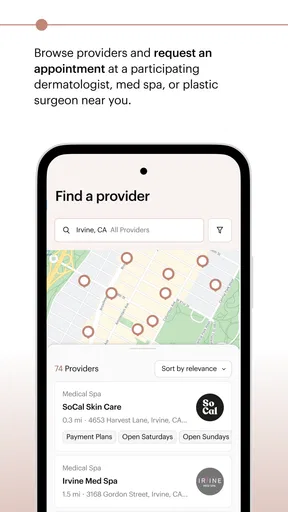
Allē is a loyalty and savings platform from Allergan Aesthetics that lets eligible users discover offers, earn points, and receive rewards on participating aesthetic treatments and products. After creating an account, you can review available promotions, track your points, and look for participating providers. Availability and benefits may vary depending on your location, treatment, provider, and current program rules.
How do I earn and redeem points in Allē?
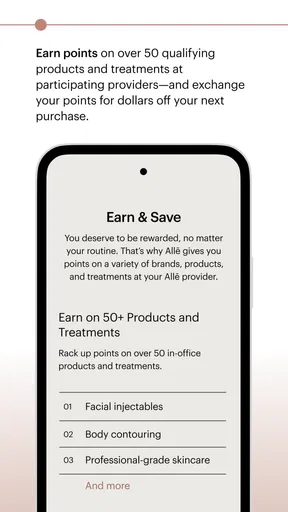
Points are generally earned through qualifying purchases or treatments at participating providers, as well as selected promotions available through the program. Once points appear in your account, you may be able to redeem them toward eligible services or products according to the current terms. Before making a purchase, check the offer details, expiration date, exclusions, and redemption requirements because not every transaction qualifies.
Is Allē free to download and use?
The Allē app is typically free to download, and creating a membership account does not usually require a subscription fee. However, the app does not make treatments or products free by itself; you still pay participating providers for eligible services. Any rewards, discounts, or promotional credits are subject to program conditions, and some offers may require a minimum purchase or have other restrictions.
Is Allē available everywhere, and which providers accept it?
Allē availability depends on your country or region, and the participating provider network may change over time. The app can help you find eligible locations and review offers, but you should confirm participation directly with the clinic before booking or paying. A provider may offer certain Allergan Aesthetics products while excluding other services, promotions, or redemption options.
What personal information does Allē require, and is the app safe to use?
Allē requires account information so it can manage your membership, points, offers, and transaction history. Depending on how you use the service, you may also share contact or treatment-related details with the platform or participating providers. Review the app’s privacy policy, permissions, and terms before registering, use a strong unique password, and download the application only from an official app store.
